Gấu Kiểm Toán: A TikTok Channel Produced by an Agent Pipeline
A faceless Vietnamese finance-explainer channel: 3.9K followers in its first weeks, at about a dollar of API cost per video.
On its fourth day, the channel did 102,205 views in a single day, summed across every video posted so far. The day after, 122,902. It was three days old, had no existing audience — no subscriber base to notify, no cross-post from somewhere bigger, nothing — and no human had filmed, voiced, or edited a single frame of anything on it. Every video in the feed that week had come out of an AI agent pipeline: a script written, reviewed, revised; a scene plan drawn up, reviewed, revised; assets generated; the whole thing composed into a doodle-style explainer and rendered to video. My job in any of that was reading scripts and scene plans, and saying no until they were right.
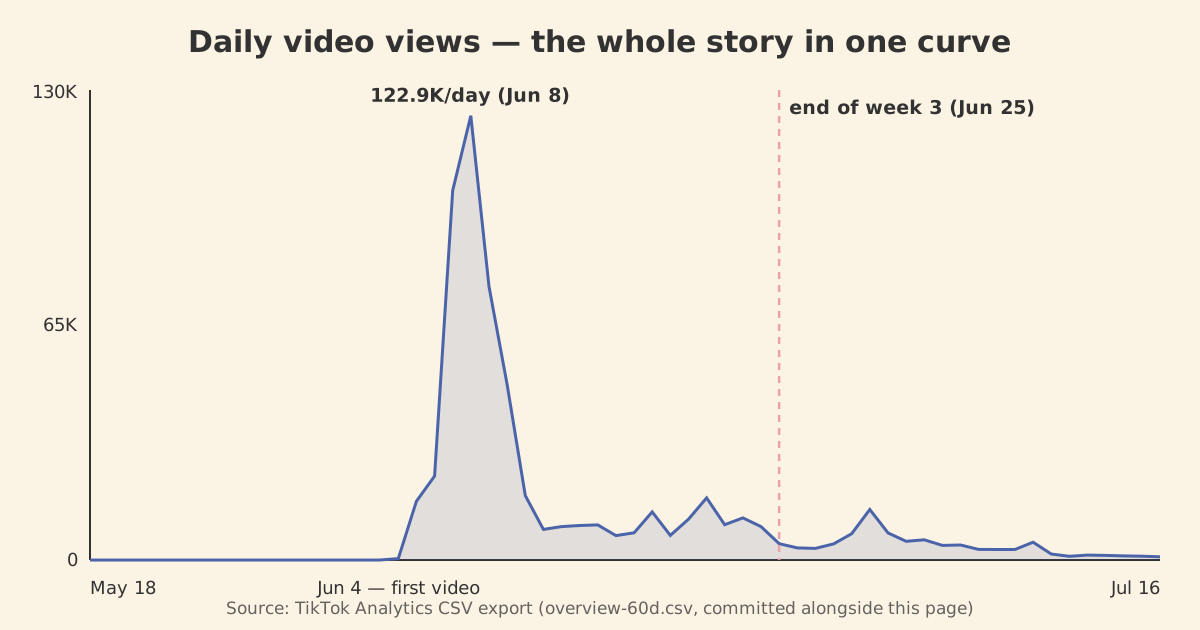
overview-60d.csv, committed alongside this page).At a glance
- What: Gấu Kiểm Toán (@gaukiemtoan), a faceless TikTok channel explaining everyday finance and business in Vietnamese, fronted by a cartoon bear.
- The result: 3.9K followers · 622.7K video views in the first ~6 weeks (the overwhelming majority inside the first three), with 80.2% of traffic from TikTok's For You feed.
- My role: Channel owner, editor-in-chief, and builder of the production layer, on top of the open-source OpenMontage platform (which I did not build).
- Stack: Claude agent orchestration · Remotion (custom doodle engine) · ElevenLabs TTS · TikTok.
- Cost: ~$1 of API calls per video; half a day to a day of wall-clock per video. Not monetized ($0.00 estimated rewards: the account isn't enrolled, and at 3.9K followers wouldn't qualify yet; monetization was never the goal).
The numbers
Over the CSV's 60-day window (17 of those days before the first video went up), the channel did 622.7K video views, 18.5K likes, 4.7K shares, and 676 comments, off 7.5K profile visits, all for $0.00 in estimated rewards, because the account isn't enrolled in any monetization program, and at 3.9K followers it wouldn't qualify yet even if it were. That's not a shortfall to explain away; monetization was never the point of this project. The point was proving a pipeline could produce a channel worth watching.
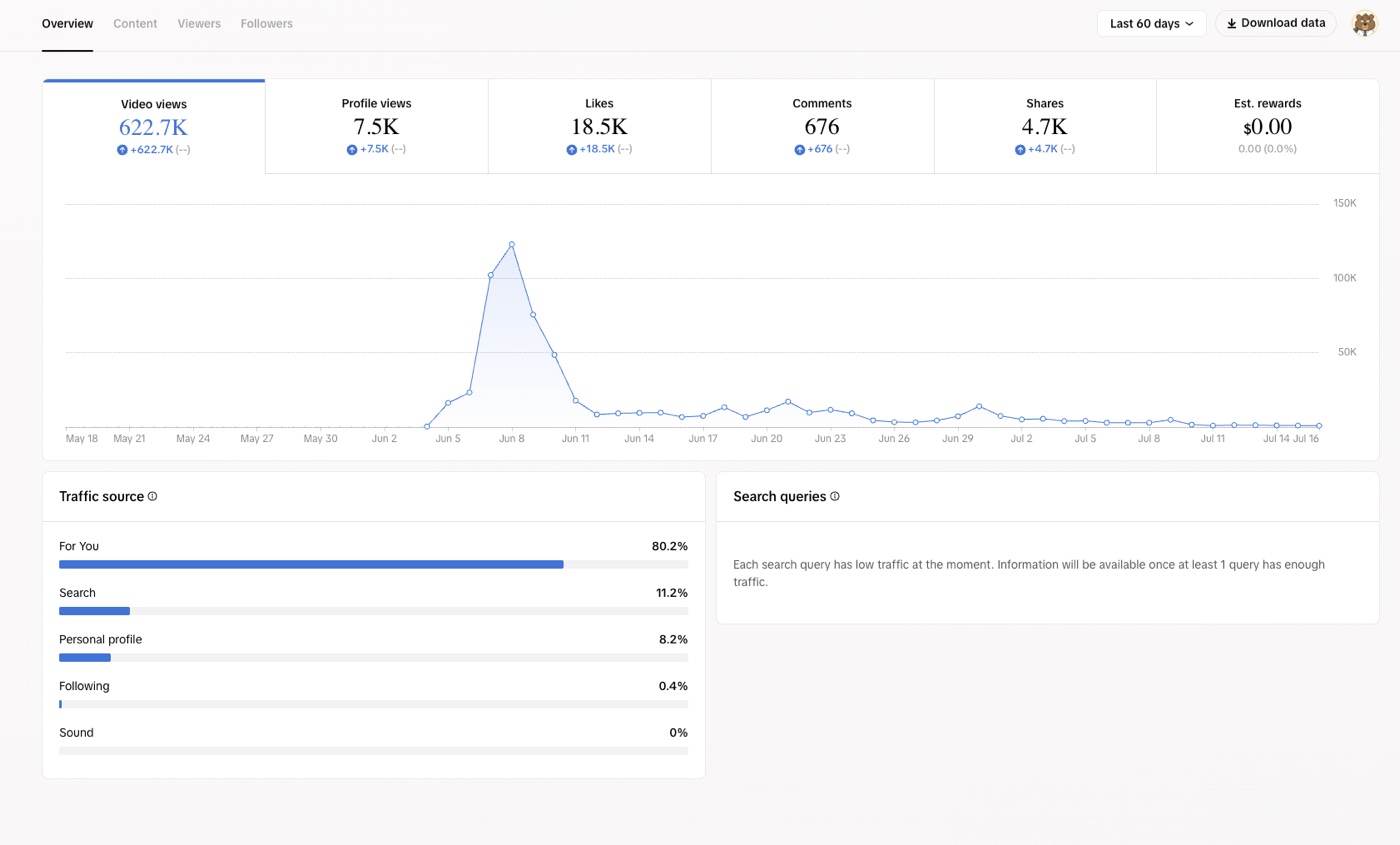
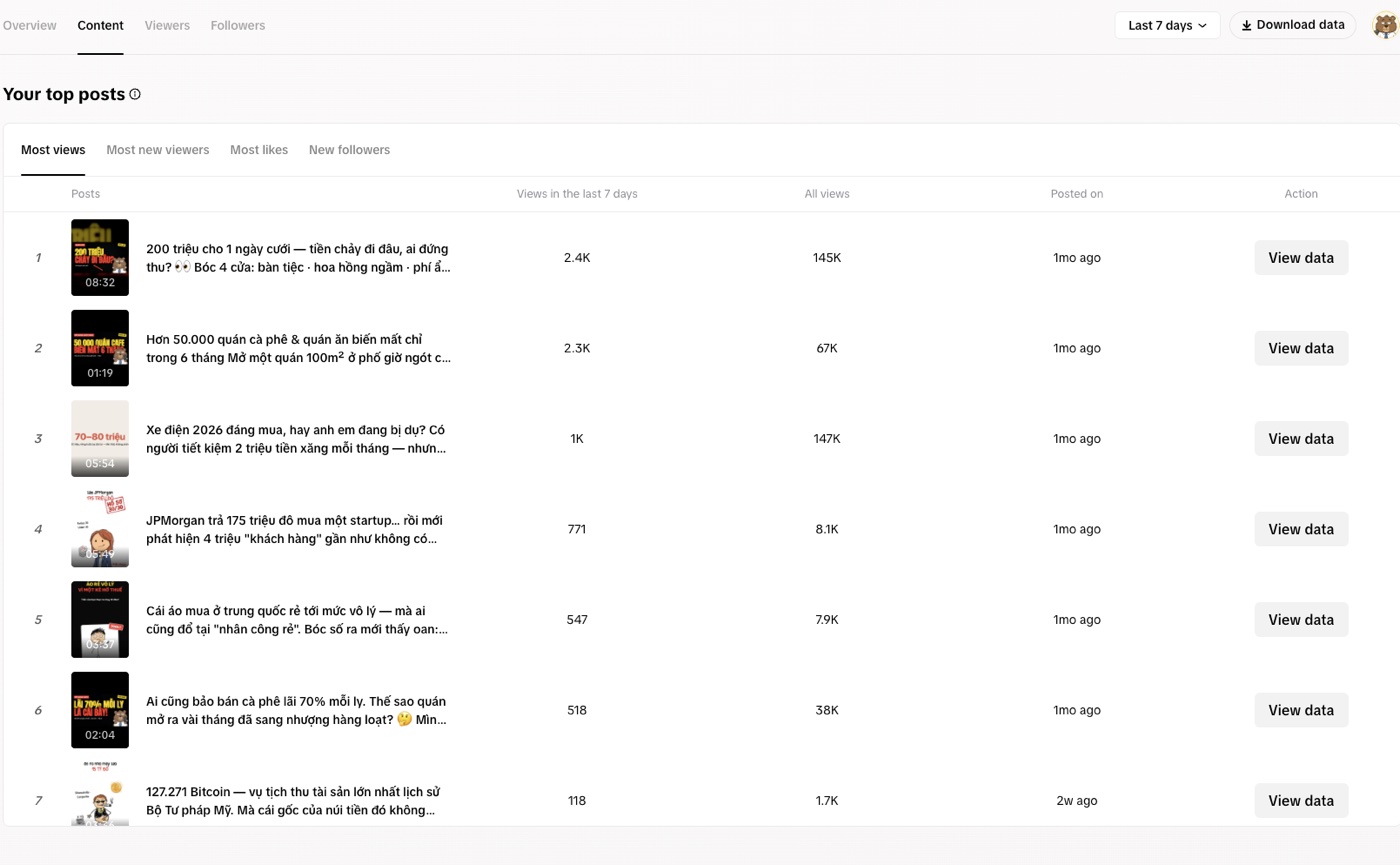
The 622.7K views behind that curve aren't evenly distributed across it. A handful of videos carried most of it, and the All views column on TikTok's own "top posts" table makes the concentration obvious (that table itself is ranked by views in the last 7 days, not by these lifetime totals): "Xe điện 2026" (should you buy a 2026 EV, or are you being played) sits at 147K all-time views, "200 triệu cho 1 ngày cưới" (where does 200 million đồng of wedding money actually go) at 145K, "Hơn 50.000 quán cà phê & quán ăn biến mất" (why fifty thousand cafés and restaurants closed in six months) at 67K, and "Ai cũng bảo bán cà phê lãi 70% mỗi ly" (everyone says coffee shops run on 70% margins) at 38K. Below that the numbers drop fast; several videos never cleared five figures.
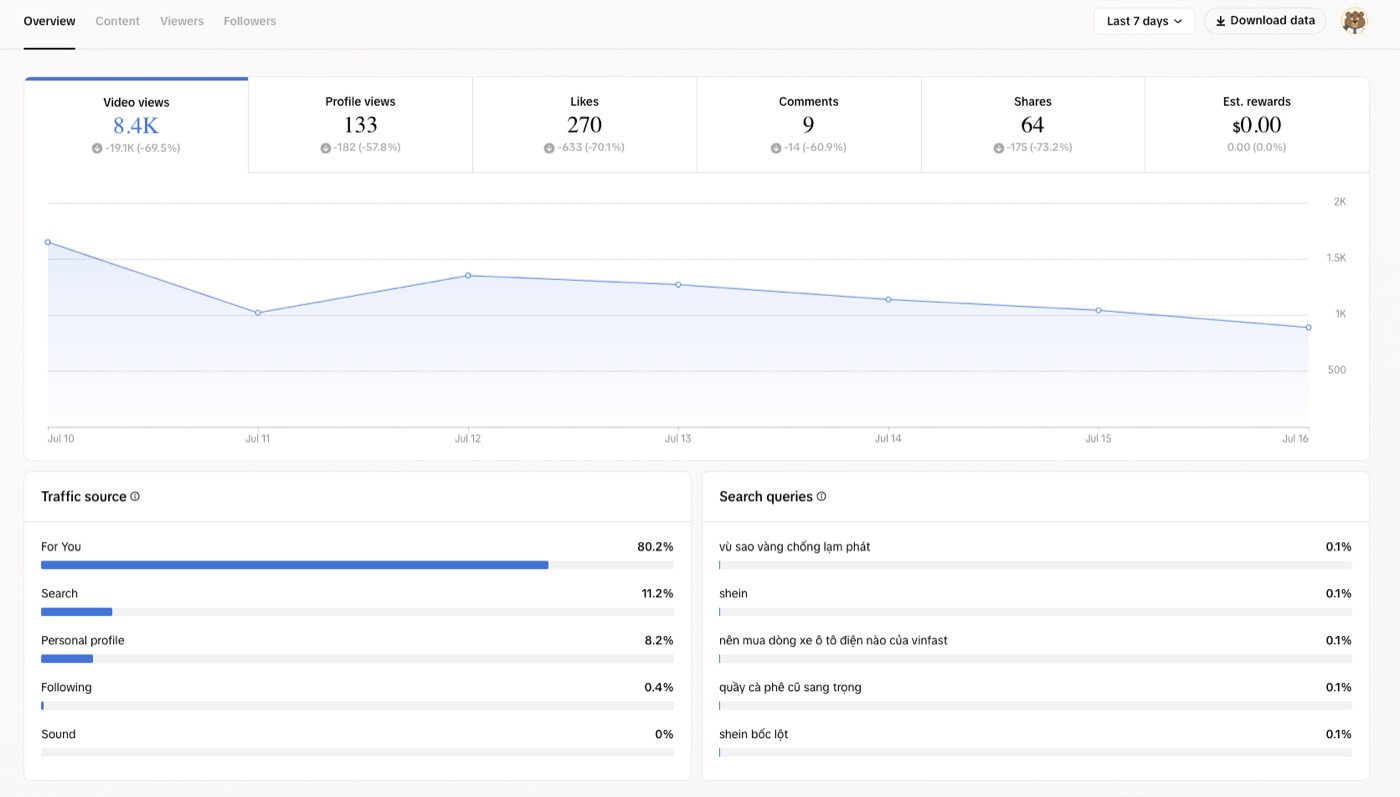
The honest tail is the last-7-days view, and I'd rather show it than not. In the most recent week the channel did 8.4K video views (down 69.5% from the week before) on 133 profile views, 270 likes, 9 comments, and 64 shares. Traffic source still reads 80.2% For You, identical to the 60-day figure, which is enough to suspect this panel isn't actually scoped to the 7-day window the way the other numbers on it are, so I won't draw a conclusion from it either way. There just isn't a new video that's caught the way the June ones did.
The machine
None of the above got made by a person sitting down to write, record, and edit a video. It came out of a two-layer pipeline, and I want to be precise about where the boundary between the two layers sits, because it's the most important honesty check in this whole project.
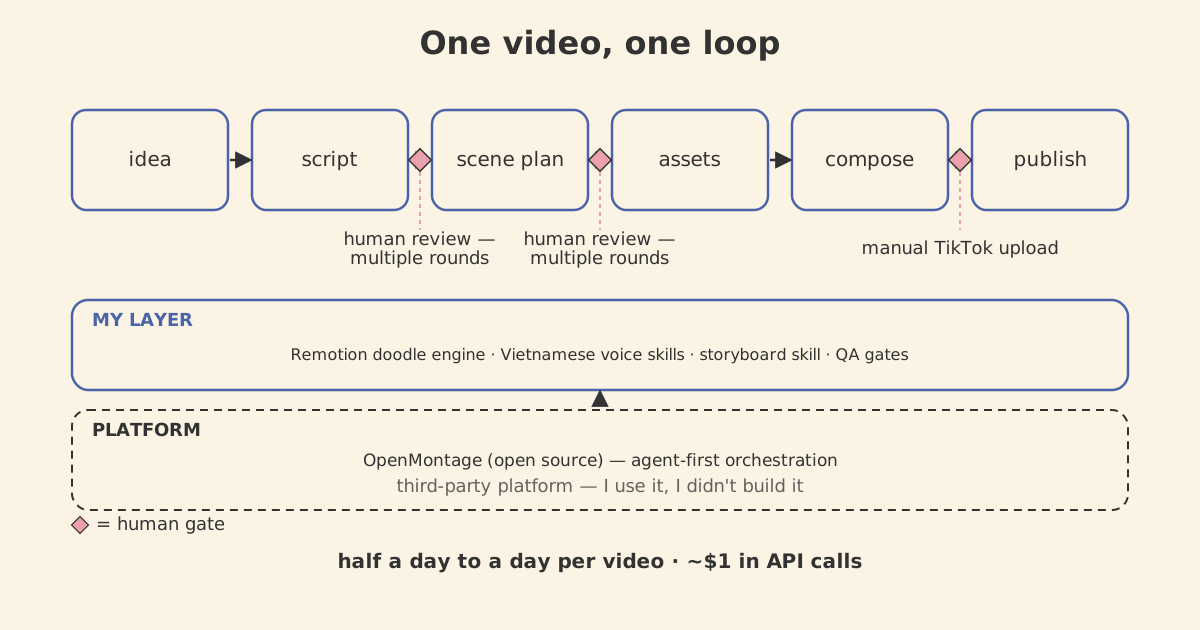
The base layer, OpenMontage, runs the mechanics: it takes an idea through script, scene plan, asset generation, and composition, with declarative manifests at each step and human-approval gates built into the flow itself. That part is genuinely third-party: I'm a user of it, crediting it here, not its author. What I built is everything that turns a generic agent-video platform into Gấu Kiểm Toán specifically: the doodle-style Remotion scene components and the per-video scene generators that draw on them, the skills that encode a Vietnamese explainer voice I distilled from channels I studied, the storyboard skill that turns a script into a scene plan the renderer can consume, and the QA checks the agent has to pass on its own before anything lands in front of me.
What "headless" actually means
I've been calling this a headless channel, and I want to be exact about what that word does and doesn't cover, because it's easy to hear "AI channel" and assume nobody was involved. Headless means no camera, no face, no editing timeline. It does not mean no human. Every video on this channel takes half a day to a day of my time, start to finish, and most of that is review: I read the script, send it back, read the revision, read the scene plan, send that back too, and only once both have cleared do I let the pipeline move on to rendering. That's multiple rounds per video, at fixed checkpoints, not a rubber stamp.
Posting is manual as well. The pipeline stops at a finished MP4; nothing in it touches TikTok's upload flow, and I've made no attempt to automate that step. If the phrase "AI channel" conjures a push-button operation — describe a topic, walk away, a video appears on the platform — this case study should talk you out of that. The agent runs the factory floor. I run the editorial desk, and the desk is where most of the hours go.
What the spike taught
The two videos that carried the June spike were "Xe điện 2026" and "200 triệu cho 1 ngày cưới": an EV-buying question and a wedding-budget breakdown, both ordinary personal-finance topics a Vietnamese viewer runs into in daily life. Nobody watching either one knew or cared that an agent pipeline had produced it; the video either answered a question they had or it didn't. That's the first lesson: the production method is invisible to the audience, and the only thing that earns a For You placement is whether the content itself is worth fifteen seconds of someone's attention.
The plateau after week three is the second lesson, and it's the less flattering one. The algorithm handed the channel a spike on its own; keeping that spike going, or reproducing it, hasn't happened yet, and it isn't a pipeline problem; the pipeline renders whatever script clears review just as reliably in July as it did in June. It's a content problem: finding the next "200 triệu cho 1 ngày cưới" is a question of topic selection and hook quality, not compute, and no amount of rendering capacity substitutes for that.
The economics
Each video costs about a dollar in API calls: script generation, scene planning, voice synthesis, the works. Against what a scripted, voiced, animated explainer normally costs to produce, that number alone would be the headline of this case study if I let it be. I don't think it should be, because the dollar figure isn't the bottleneck.
The marginal cost of another video, in compute, really is about a dollar. The marginal cost in my attention is hours: reading a script closely enough to catch a wrong number or a flat hook, reading a scene plan closely enough to catch a beat that won't land visually, doing that across multiple rounds, per video. That second cost is the one that doesn't scale, and it's the actual constraint on how many of these I can ship in a week.
Where this goes
This channel is a proving ground for the pipeline, not a media business I'm running. The pipeline is the thing I built; the channel is how I found out whether it makes something an algorithm will actually hand to strangers. It does, and it cost about a dollar an episode to find that out.
Whether I take it further is open. At something like 50K followers there'd be an audience worth selling into (a course, a product), and I'd want to. But the curve has been flat for a month. That's an ambition, not a plan.
Either way it comes back to the review loop. More videos is the only route to any of it, and what caps how many I ship is the rounds of script and scene-plan review that have to reach me first. That's the piece I know how to engineer.